00 · Why This Project Exists
The Problem Beneath the Problem
When I examined Zoho One, the friction was visible immediately. Users switching between CRM and Desk lost context at the product boundary. Moving from Campaigns to CRM required manual re-orientation. Navigating from Projects into Books reset the session entirely. The behaviors were consistent. The causes appeared to be navigational.
My initial instinct was to address this at the surface. Better cross-product navigation. Unified sidebar patterns. Richer contextual linking between products. These are the natural tools of a product designer, and they are genuinely useful. I began framing an intervention along those lines.
The framing did not hold. The more precisely I defined the friction, the more clearly it pointed below the interface layer. Session resets were not a navigation problem — they were a session contract problem. Context loss at the CRM-to-Desk boundary was not a link design problem — it was the absence of a platform-level context carrier. Permission inconsistencies across CRM, Books, and Desk were not configuration problems — they were the structural outcome of 45 independently governed permission architectures.
UI changes cannot eliminate session resets. Navigation patterns cannot carry context that no runtime layer preserves. Feature additions cannot resolve what is, structurally, a coordination failure at the platform level. Each of these surface interventions would improve the experience within its own boundary — and leave the underlying cause intact.
So the direction of this work moved downward. Fix the runtime layer first. Define what structural primitives Zoho One requires in order for its 45 products to coordinate. Then move upward — toward surface interventions that have a stable substrate to rest on. This document records that structural analysis, the intervention model it produces, and the design argument it implies for anyone operating at the platform scale.
Design Argument
Designers often attempt to fix surface friction with surface tools. Scalable SaaS architecture requires a different premise: that runtime awareness must precede — and constrain — the surface design layer. What cannot be resolved at runtime cannot be compensated for at the interface.
01 · Executive Brief
What Zoho One Is, and What It Is Not
Anchor Proposition
Zoho One aggregates 45+ products under a single commercial license. It does not coordinate them at runtime. The gap between those two facts is the structural problem this case study addresses.
What Zoho One Is
Zoho One is a commercially unified operating suite — a single license granting access to a full-stack business product portfolio covering CRM, customer support (Desk), accounting (Books), marketing automation (Campaigns), project management (Projects), and more than forty additional applications. The commercial unification is genuine: one contract, one admin console, one billing relationship.
The products themselves were developed largely as independent systems. Each product was designed, architected, and deployed as a self-contained application with its own session model, its own permission architecture, its own data model, and its own navigation patterns. They are hosted on separate subdomains. They authenticate independently. They hold no platform-level awareness of one another's state.
The Core Structural Flaw
Zoho One has a commercial coordination layer. It does not have a runtime coordination layer. These are not the same thing. The commercial layer governs the license. The runtime layer — which does not currently exist — would govern how products interoperate: how session context moves between CRM and Desk, how a permission role defined in the admin console propagates consistently across Books and Projects, how a workflow transition from Campaigns to CRM preserves the entity a user was acting on.
In the absence of a runtime layer, coordination is performed by users. They maintain browser tabs to preserve product views they cannot afford to lose. They keep external notes to track state the platform does not carry. They re-orient at each product boundary, searching for the record they were just looking at. This labor is invisible in session analytics. It is not invisible in enterprise retention data or in the escalation patterns of power users who manage workflows across multiple products daily.
Commercial Consequence
The commercial proposition of Zoho One is integration — a single platform replacing a fragmented tool stack. The operational reality is that the products are not integrated at the layer users depend on at runtime. This gap is not a perception problem. It is a structural gap. Enterprise accounts evaluating Zoho One as a platform consolidation play encounter it directly. The commercial case and the operational experience are misaligned.
What Runtime Continuity Changes
A runtime coordination layer — built incrementally across four structural phases — would close this gap. It would make session context persistent across product transitions. It would make entity references propagate from CRM to Desk to Books without manual re-location. It would make permission roles consistent across the 45-product portfolio rather than independently configured per-product. And it would provide the observability substrate that any AI-layer capability requires to operate across product boundaries.
02 · Structural Diagnosis
Five Failure Classes
Zoho One's structural condition produces five distinct failure classes. Each is a direct consequence of commercial unification without runtime coordination. Each would require a different surface-layer workaround. None can be resolved at the surface layer.
| Failure Class | Structural Origin | Manifests As | Resolvable by UI? |
|---|---|---|---|
| Context Reset | No cross-product session contract | Full page reload on every product switch. Entity context, active record, and workspace scope are lost at each boundary. | No |
| Orientation Cost | No context carrier between products | Users spend 60–120 seconds re-locating the entity they were working on after each product switch. Re-orientation is manual and recurring. | No |
| Permission Fragmentation | 45 independent permission architectures | Admin roles must be configured separately per product. Organizational role changes do not propagate. Enterprise admin overhead accumulates per product added. | No |
| Navigation Fragmentation | No platform shell; independent product chrome | Each product presents its own navigation, sidebar, and global chrome. Context switching breaks the user's mental model across products. | Partially |
| Entity Fragmentation | Independent data models per product | "Meridian Group" in CRM is unrelated to Meridian Group in Desk. No canonical entity reference exists. AI cross-product suggestions cannot be grounded. | No (out of scope) |
Root Cause
All five failure classes share a single origin: Zoho One has a commercial coordination layer and no runtime coordination layer. This proposal adds the runtime layer. Entity fragmentation — the fifth class — requires separate canonical entity infrastructure and is explicitly outside this proposal's scope.
Diagram 1 — Zoho One Fragmentation Model
FIG 2.A — Commercially Unified · Operationally Fragmented
CRM
Separate entity model
Separate permission model
Separate session state
Desk
Separate entity model
Separate permission model
Separate session state
Books
Separate entity model
Separate permission model
Separate session state
Campaigns
Separate entity model
Separate permission model
Separate session state
Projects
Separate entity model
Separate permission model
Separate session state
What This Proposal Addresses — and Does Not
Addressed by this proposal
Context reset — via context propagation model and Context Bus
Orientation cost — via persistent platform shell and workspace context primitive
Permission fragmentation — via Role Template abstraction layer
Navigation fragmentation — via shell invariants governing global chrome
Not addressed — different scope
Entity fragmentation — requires canonical entity modeling, a separate infrastructure initiative
Data model unification — each product retains its own data model
Real-time cross-product sync — context is broadcast, not synchronized
03 · Observed Behavioral Signals
Platform Failure Presenting as User Behavior
The structural failures in Section 02 manifest as observable user behaviors. These behaviors are commonly misread as individual productivity habits. They are system signals.
Tab Proliferation
Account managers in cross-product workflows maintain 8–12 browser tabs simultaneously. Each tab preserves a product view that would be lost on navigation. The user is performing context preservation manually because the platform provides no mechanism to do it structurally. Tab count is a direct behavioral proxy for platform coordination failure.
Manual State Tracking
Users maintain external records — spreadsheet columns, personal notes, physical annotations — to track entity state across products. "ARR in CRM, invoice status in Books, ticket count in Desk" is not a workflow preference. It is reconstruction labor introduced by the absence of a cross-product state model.
Diagnostic Signal
Elevated tab count per multi-product session and the presence of external state-tracking artifacts are the two most reliable behavioral indicators that the platform has transferred its coordination responsibility to the user. When users externalize system state to maintain their own continuity, this is a governance failure — not a UX failure. It requires a structural response, not a surface intervention.
Methodological Note
The behavioral patterns described in this section are structural observations derived from platform analysis and publicly observable product behavior. They are not statistically quantified outputs from controlled research. They are diagnostic patterns: consistent, structurally explicable behaviors that a runtime coordination layer would eliminate regardless of their precise frequency. Quantification of their economic magnitude requires the studies identified in Section 10.
CRM → Desk: Context at the Boundary
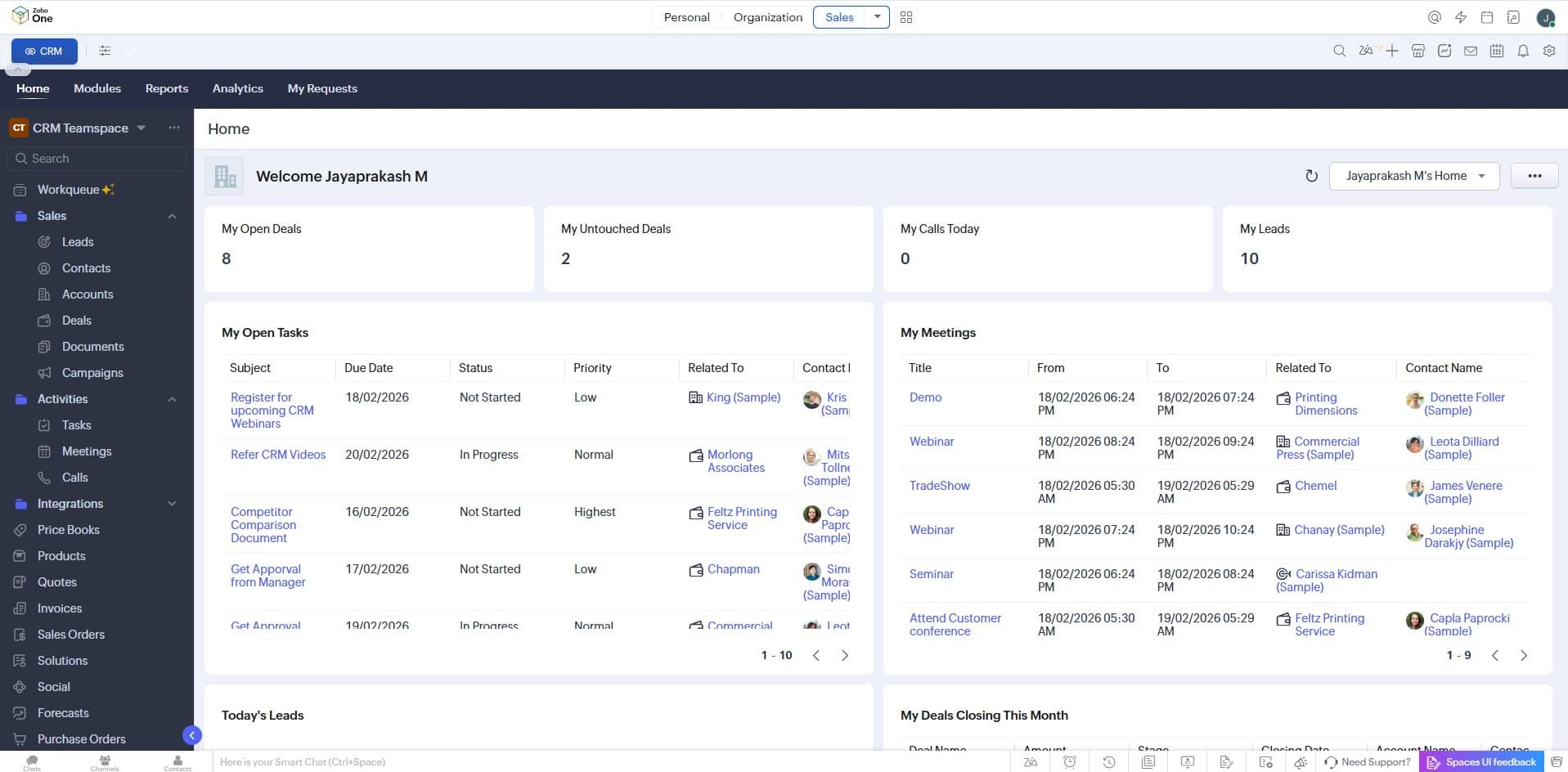
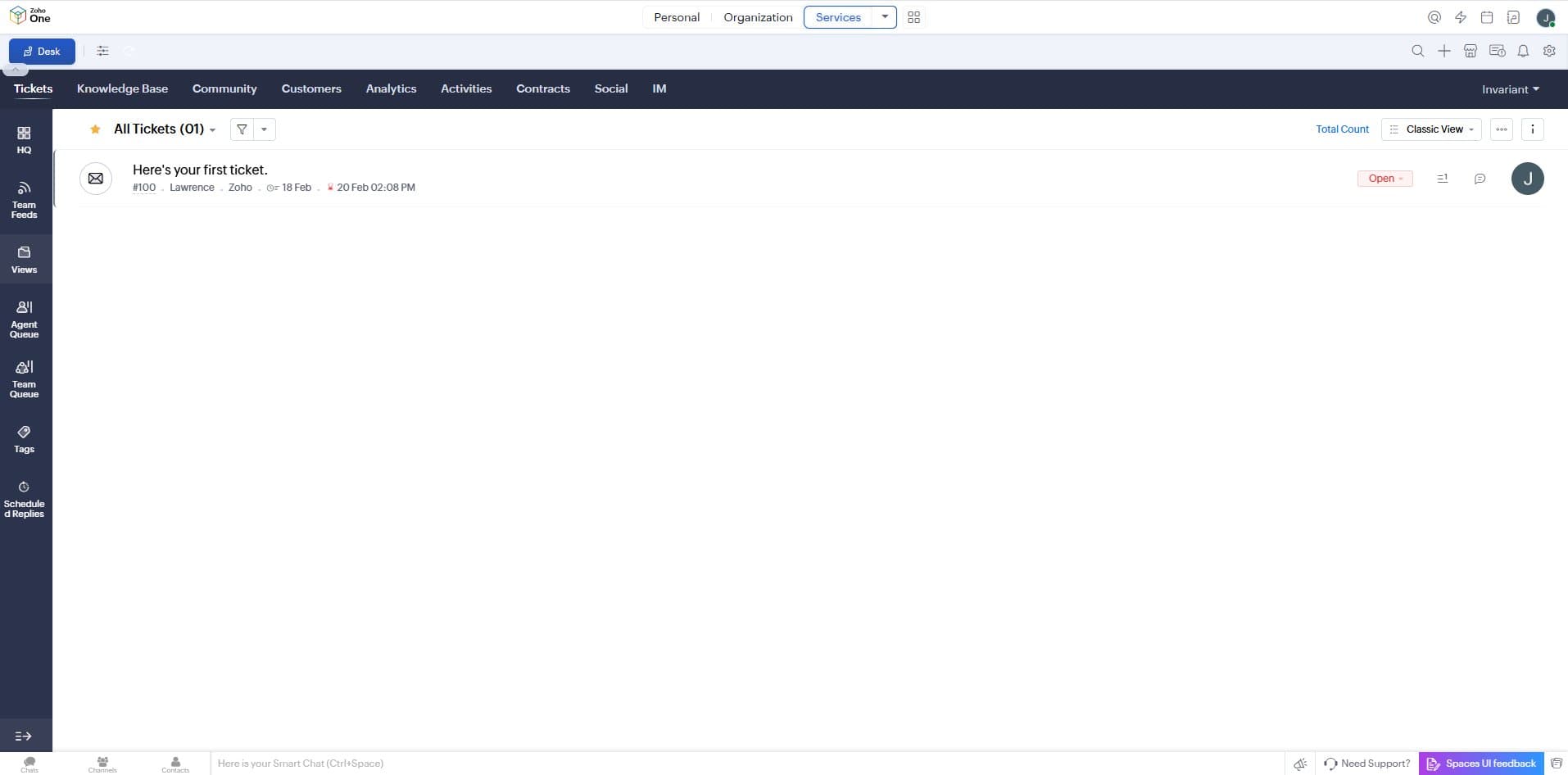
FIG 3.A — Context Carrier: Current vs. Proposed Runtime Layer
CRM · Current
Session-local state
Entity: Meridian Group Scope: product boundary only
Context Carrier · Current
Human memory + tabs
Manual · unreliable · does not scale
Desk · Current
Session reset
State: default view Entity: unknown
CRM · Proposed
Publishes entity_selected
Session: SDK-managed Broadcasts workspace token
Runtime Layer
Context Bus
Routes token to subscribers Scoped to shell session
Desk · Proposed
Receives entity context
Filters: Meridian tickets Entity resolved per-product
04 · Runtime Intervention Model
Three Platform Primitives
The intervention introduces three platform-owned primitives. Each is independently deployable. None requires modification of existing product architectures. Each delivers standalone value before the others are complete.
01
Platform Shell
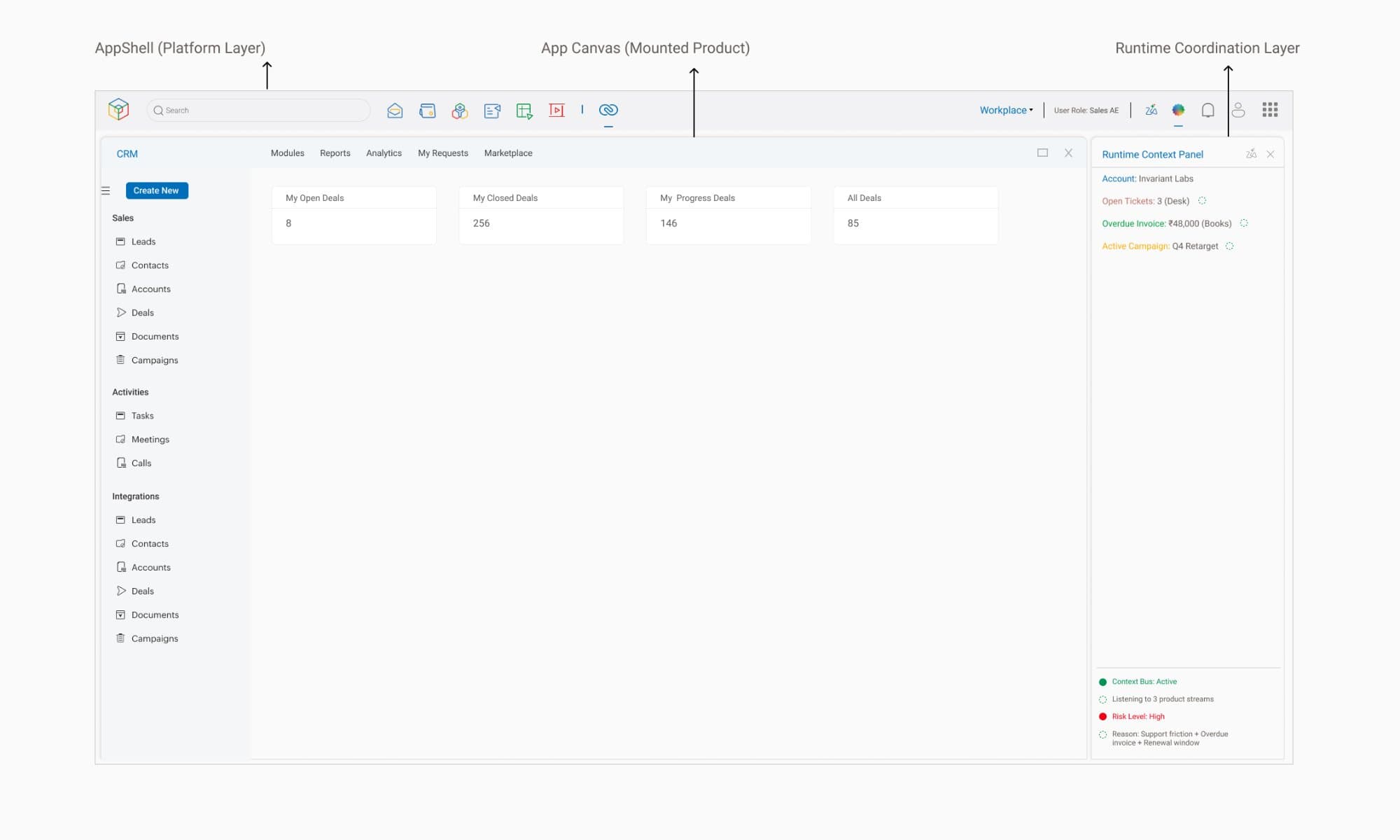
A persistent, platform-owned chrome layer that hosts all Zoho products via controlled iframe embedding. The shell provides invariant navigation, workspace context display, and command palette — regardless of which product is active. Products do not own their top chrome once the shell is deployed.
02
Workspace Context Primitive
A platform-level context token — carrying workspace ID, active entity reference, and role scope — that persists across product transitions. Products consuming this token do not need to re-authenticate the workspace scope or re-locate the active entity independently.
03
Context Bus
A platform-managed event bus with a defined schema for cross-product state events: entity_selected, workspace_changed, notification_action. Products subscribe and publish through SDK contracts. The bus routes events to all subscribing products active in the current shell session.
Diagram 2 — Runtime Coordination Layer
FIG 4.A — Proposed Runtime Architecture · Zoho One
Zoho Products
CRM · Desk · Books · Campaigns · Projects · 40+ others
Canvas
Iframe embedding · Product isolation boundary · Layout contract
AppShell
Persistent chrome · Command palette · Workspace switcher · Session continuity
Context Bus
entity_selected · workspace_changed · notification_action · schema-governed
SDK Contracts
Product registration · Session handshake · Permission scope declaration · Context subscription
Runtime Coordination Layer
Platform-governed · Product-independent · Session-persistent · AI-observable
05 · Primitives in Zoho Context
Grounded in Real Product Flows
Canvas — CRM to Books
In the current architecture, navigating from a CRM deal record to its associated Books invoice is a hard navigation. The user leaves crm.zoho.com and arrives at books.zoho.com at the default dashboard view. The deal context — account name, deal stage, ARR — is abandoned. The Canvas layer changes this: CRM and Books are both embedded within the platform shell. Switching focus is a shell-level operation. The CRM pane remains mounted; Books receives the entity context before rendering.
AppShell — Campaigns to CRM
A marketing operator running a Campaigns workflow that qualifies a lead needs to hand that lead to CRM for follow-up. Currently, this involves navigating out of Campaigns entirely, re-authenticating the workspace scope in CRM, and manually locating the lead record. The AppShell maintains a persistent workspace context token. When the operator transitions from Campaigns to CRM, the token carries the workspace scope and — via Context Bus — the entity reference. CRM opens pre-filtered to the relevant lead. Orientation cost at this boundary drops from manual reconstruction to zero.
Context Bus — Projects to Books
A project manager approving a milestone in Projects needs to verify the associated invoice status in Books. The Context Bus carries an entity_selected event from Projects — including the project ID and workspace token — to Books, which maps the project entity to its associated invoice and surfaces it in the context panel. The project manager does not navigate, does not search, does not reconstruct.
SDK Contracts — CRM to Desk
The CRM→Desk boundary is the highest-frequency cross-product transition in Zoho One for accounts teams. SDK v2 defines the contract: CRM publishes entity_selected with the account ID and workspace scope when an account record is focused. Desk subscribes to this event and pre-filters its ticket view to that account. Neither product modifies its internal data model. The SDK contract is the coordination mechanism; both products retain full architectural independence.
06 · Designer Thinking Layers
Why Feature-First Thinking Fails at Scale
Most product design work occurs at Layer 1: UI, flows, features, interaction patterns. This is where design tooling operates. It is where design reviews occur. It is where most design portfolios are constructed. It is a legitimate and necessary layer. It is not sufficient for platform-scale systems.
When a product designer addresses the CRM→Desk context loss by proposing a richer deep-link pattern or a contextual drawer, they are operating correctly within L1. The intervention is coherent within its layer. It will improve the experience at that specific boundary, within that specific product pair, for the transition paths they have mapped. It will not remove session resets. It will not eliminate orientation cost at the twelve other product boundaries an enterprise user crosses in a single working session.
Feature-first thinking fails at scale not because features are wrong, but because features execute on a runtime substrate — and if that substrate is ungoverned, the features compound the fragmentation rather than resolving it. Each new cross-product integration built as a point-to-point feature adds another dependency pair that must be maintained, monitored, and debugged independently. At 45 products, point-to-point integration is not a strategy. It is technical debt accumulation with a product label on it.
Diagram 3 — Designer Thinking Layers
FIG 6.A — Product Thinking Layers — Required Depth for SaaS Scale
UI / Feature Layer
Components · Flows · Interaction patterns · Visual design
Workflow Layer
User journeys · Cross-feature task flows · Information architecture
Runtime Coordination Layer
Session contracts · Context propagation · Permission governance · Platform primitives
Infrastructure Layer
Data models · Auth systems · API contracts · Platform hosting
Why Runtime Awareness Must Precede Feature Design
A feature designed for Zoho CRM that surfaces Desk ticket counts in the account view is useful. It is also fragile: it is a point-to-point dependency between two products that do not share a session model. When the Desk team updates their ticket API schema, the CRM feature breaks. When an admin restricts a user's Desk access, the CRM feature surfaces an error state that CRM's design system was not built to handle gracefully. The feature's runtime environment is ungoverned. Its failure modes are inherited from that gap.
Runtime awareness at L3 is not backend engineering knowledge. It is the ability to ask: what does this feature depend on that the platform does not currently guarantee? This is why runtime governance must precede feature design at scale. The runtime layer defines what features can legitimately rely on. Features built before that layer is in place are building on an undeclared contract — one that will be renegotiated, silently, every time a product team makes an independent architectural decision.
Design Principle
You cannot design scalable features without understanding the runtime layer they execute on.
07 · Governance Specification
SDK Contracts and Permission Architecture
SDK Contract Structure
The SDK is not optional tooling. It is the mechanism through which products register with the platform shell. SDK compliance is the gate for shell embedding. A product that has not implemented the SDK handshake cannot be embedded in the AppShell — it remains accessible via its direct subdomain URL, but receives no context from the platform and does not participate in Context Bus events.
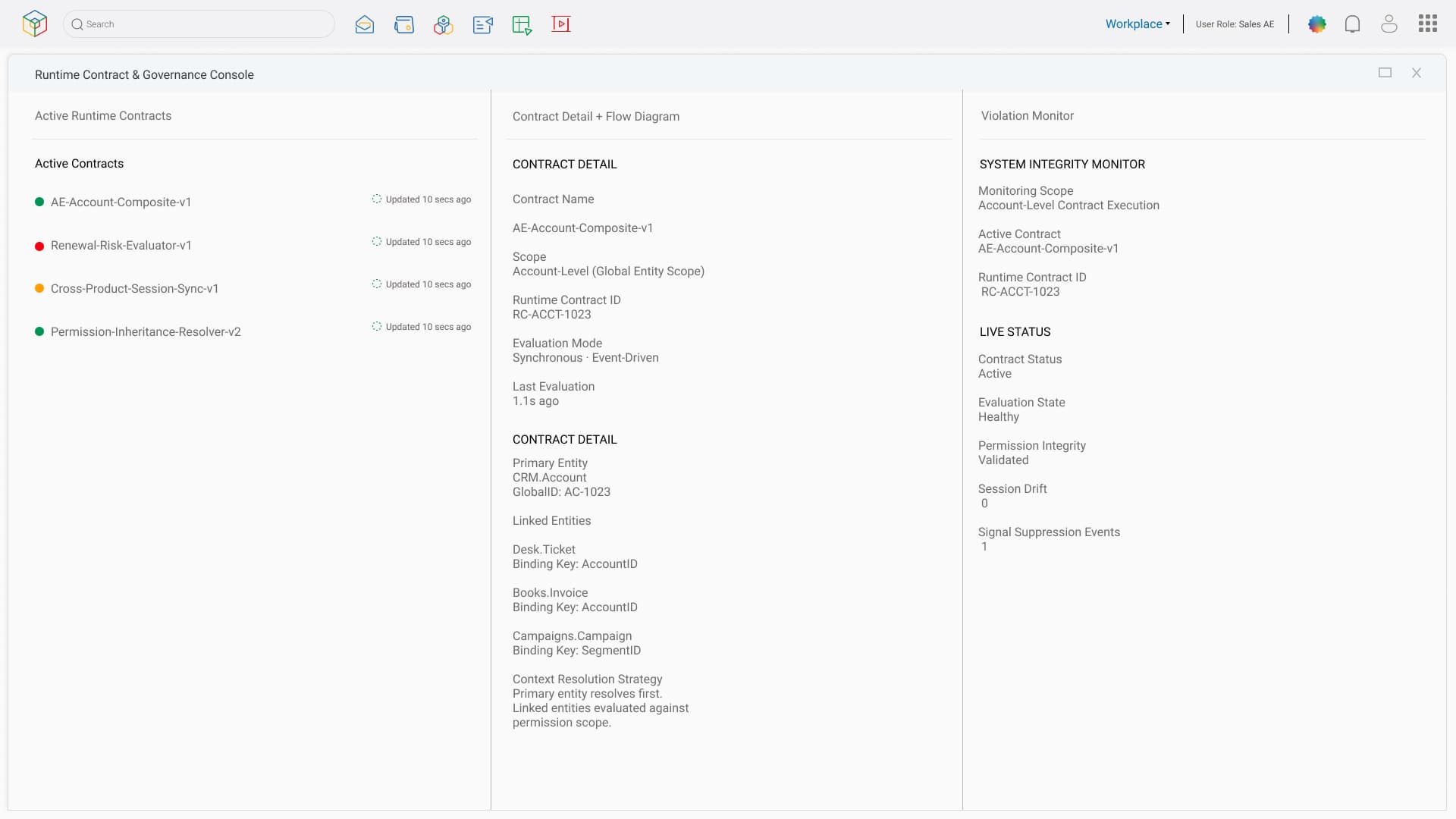
Role Template Architecture
The current Zoho One permission model requires admins to configure roles independently per product. An admin adding a new account executive must configure access in CRM, Desk, and Books separately. Each product's permission architecture is independent. There is no inheritance, no cross-product role template, no platform-level abstraction.
The Role Template Builder — a Phase 2 admin surface — introduces a cross-product role abstraction. A "Sales AE" template declares the capabilities this role requires across CRM (account edit, deal create), Desk (ticket view, comment), and Books (invoice view). The template is deployed once. When an admin creates a new user with the "Sales AE" role, all three product-level permissions are provisioned from the template. Template conflicts surface in the admin console for explicit resolution rather than producing silent misconfigurations.
08 · Migration Strategy
Phased Deployment Under Constraint
This is not a clean-room implementation. Zoho One has deployed customers, active workflows, shared deep links, and 45 autonomous product teams. The deployment model must accommodate all of these while adding coordination. Each phase is independently valuable and independently deployable.
Phase 1 · M1–9
Shell Invariance
Deploy unified shell above all products. Iframe embedding. Command palette, notification aggregation, workspace switcher. SDK v1 published. Initial cohort: 5–7 products by workflow co-occurrence (CRM, Desk, Books as first tranche).
Delivers: Nav + visual coherencePhase 2 · M6–18
Permission Abstraction
Role Template Builder in admin. Workspace context token broadcast to SDK v1 products. Split surface gated by AppShell contract compliance and device performance check.
Delivers: Admin clarity + split surfacePhase 3 · M18–30
Context Propagation
Context Bus live with initial schema: entity_selected, workspace_changed, notification_action. SDK v2 published. Context banner active. v1/v2 coexistence enforced. CRM→Desk and Campaigns→CRM as first implementing pairs.
Delivers: Cross-product continuityPhase 4 · M30+
AI Substrate
AI layer gains cross-product observability via Context Bus event stream. Proactive next-action suggestions across product boundaries. Third-party automation access to event schema.
Delivers: Runtime AI integrationRuntime Monitoring Interface — Conceptual
Phase 4 observability layer enabling AI readiness.
Backward Compatibility
All existing Zoho subdomain URLs must remain functional throughout and after shell deployment. The compatibility layer maps legacy URLs to shell-managed URLs and is deployed before the shell goes live. Legacy links shared via email or bookmarks continue to function. The ?legacy=true flag suppresses workspace context injection for that navigation — preventing stale context from contaminating shared-link destinations.
SDK Adoption Governance
Phase 3 deployment is gated by SDK adoption coverage, not calendar date. The target threshold is 60% of active product pairs — measured by session co-occurrence — implementing the AppShell session contract before Context Bus goes live. Product teams receive a monthly SDK adoption report: current contract status, estimated benefit value from co-occurrence data, and blocking implementation issues. Adoption is incentive-governed, not mandated.
08A · Failure Scenario
Partial SDK Adoption — Graceful Degradation
The migration model assumes incentive-governed adoption, not mandated compliance. This means partial SDK implementation is not an edge case — it is the expected operational condition for the majority of the deployment window. The governance layer must be designed to tolerate it without breaking the shell or regressing behavior for products that have adopted.
Scenario: Desk Does Not Implement SDK v2
CRM implements SDK v2 and begins publishing entity_selected events to the Context Bus for every account record focus. Desk has not implemented SDK v2. It remains at SDK v1 — shell-registered, session-token-aware, but not subscribed to Context Bus events. The platform must handle this asymmetry without degrading CRM's behavior or exposing users to undefined states.
Shell Behavior
Shell continues operating normally. CRM publishes entity_selected events. The Context Bus routes the event to its subscriber registry. Desk is not in the registry — it simply does not receive the event.
No shell crash. No error state propagation. The shell has no dependency on any specific product having implemented SDK v2.
The shell's workspace context token is still delivered to Desk on mount via SDK v1. Desk initializes with workspace scope. It does not initialize with the CRM entity context.
Context Propagation Degradation
Context propagation degrades gracefully to SDK v1 behavior at the CRM→Desk boundary. Desk loads with workspace scope intact but no entity pre-filter.
No regression below baseline. The user's experience at that specific boundary is no worse than before shell deployment. The orientation cost they already carry is preserved, not added to.
Products that have adopted SDK v2 — e.g., CRM→Campaigns — benefit fully from context propagation regardless of Desk's adoption status.
Legacy Subdomain Fallback
If Desk is navigated to via its legacy subdomain — desk.zoho.com — the compatibility layer handles the redirect to the shell-managed URL. The ?legacy=true parameter may be appended for navigation originating from unmanaged external links, suppressing workspace context injection for that session load. No context contamination occurs.
Event Subscription Failure
If a product has partially implemented SDK v2 — registered for Context Bus subscription but not correctly handling the event schema — the bus emits the event and the product's handler fails silently. The failure is contained within the product's own iframe. The shell does not catch or propagate product-internal errors. The Context Bus does not retry delivery. Unhandled failures are logged to the platform monitoring layer for the SDK adoption report — they do not affect shell stability or other products' event streams.
Governance Principle
Governance layers must assume incomplete compliance during transition. A coordination architecture that requires 100% adoption before it delivers any value is not deployable in a system with 45 autonomous product teams. The failure modes here are defined, bounded, and non-regressive. Products that adopt benefit. Products that do not adopt continue operating as before. This is the correct design posture for phased platform governance.
08B · Embedded Execution
If I Were Embedded Inside Zoho
This proposal is a structural argument developed from the outside. The following section translates it into an operational execution sequence for the scenario where I am embedded within Zoho's platform team — with access to session data, product team relationships, and internal engineering capacity. It is grounded in enterprise constraints: 45 product teams with independent roadmaps, no mandate authority, and a live customer base that cannot be disrupted.
First 30 Days
Diagnostic Foundation
Map session analytics for cross-product transition frequency. Identify the 5 highest co-occurrence product pairs from behavioral data — not assumptions. Establish stakeholder alignment with CRM, Desk, and Books product leads. Frame the shell as a platform-level capability, not a product redesign imposed on their roadmaps.
Output: Co-occurrence map + stakeholder alignment60 Days
SDK v1 Pilot
Run SDK v1 pilot with the highest-frequency product pair identified from co-occurrence data — most likely CRM + Desk. Shell-only rollout: no Context Bus, no entity propagation. Instrument orientation cost baseline using session replay. Define the measurement protocol before Phase 3 so the delta is observable.
Output: Orientation cost baseline + SDK v1 in first pair90 Days
SDK v2 Pilot + Permission Prototype
Initiate SDK v2 design with engineering: define entity_selected event schema, agree on entity resolution contract between CRM and Desk product teams. Begin Role Template prototype inside the Admin Console — scoped to one organizational role ('Sales AE') across CRM, Desk, and Books as the proof-of-concept configuration.
Output: SDK v2 schema draft + Role Template prototypeBeyond
Governance Model
SDK adoption incentive model: monthly adoption report to product teams, co-occurrence benefit estimates, blocking issue triage. Context Bus deployed when 60% adoption threshold is reached. Phase 3 gated on measurement, not calendar.
Output: Governed adoption + Context Bus readinessFraming Note
This is not a redesign exercise. It is a staged governance intervention. The deliverable at 30 days is a co-occurrence map and stakeholder alignment — not a prototype. The deliverable at 60 days is a measurement baseline — not a shipped feature. At 90 days, the deliverable is a draft schema and an admin-console proof of concept. The shell and Context Bus come after the diagnostic work confirms the co-occurrence priorities and after engineering capacity is allocated. Governance precedes implementation.
08C · Competitive Snapshot
Multi-Product Runtime Coordination — Comparative State
Zoho One is not the only multi-product suite facing runtime coordination requirements. The following table compares how comparable suites address the same structural problem. The analysis is based on publicly documented platform behavior and developer documentation. It is neutral — neither a superiority claim nor a competitive alarm.
| Suite | Unified Shell | Context Propagation | Cross-Product Permissions | Runtime Event Layer |
|---|---|---|---|---|
| Zoho One Current state | Partial — shared account shell; products on separate subdomains | None — full session reset at every product boundary | Per-product only — no cross-product role template | None — no cross-product event schema or pub/sub layer |
| Microsoft 365 Teams + SharePoint + Outlook | Yes — Microsoft Teams acts as a persistent host shell for integrated apps | Partial — context passes within Teams app integrations; cross-product context limited outside Teams host | Yes — Azure AD unified role model propagates across the suite | Partial — Microsoft Graph API provides cross-product event observability; not a real-time pub/sub bus |
| Atlassian Cloud Jira + Confluence + Bitbucket | Partial — shared global nav; products remain separately routed | Limited — issue linking provides entity references; no session context propagation | Partial — Atlassian Guard provides centralized policy; per-product role configuration still required | Partial — Atlassian Connect and Forge provide cross-product event hooks for app developers; not a platform-native runtime bus |
| HubSpot Suite CRM + Marketing + Service Hub | Yes — single-domain unified shell across all hubs | Yes — shared CRM contact object propagates context across hubs natively | Yes — unified permission model across all hubs; role changes propagate platform-wide | Partial — workflow automation layer connects hubs; not an event bus but produces coordinated cross-hub behavior |
Observation
HubSpot's advantage is architectural, not feature-level: a single shared contact object across all hubs eliminates entity fragmentation at the foundation. Microsoft 365's Azure AD provides the cross-product permission model that Zoho One's per-product configuration cannot replicate. Neither comparison is a direct analog — Zoho One's 45-product breadth is structurally different from HubSpot's focused five-hub model. The comparison identifies what a mature runtime coordination layer looks like, not what Zoho One should become.
Strategic Position
Zoho's opportunity is not feature parity. It is runtime governance maturity. Adding features to 45 products without a coordination layer produces a wider fragmentation surface, not a stronger platform. The suites that have closed this gap did so by investing in platform-level primitives — shared identity, shared entity models, persistent shells — before scaling product breadth. Zoho's product breadth already exists. The governance layer is what remains.
09 · AI Readiness
Runtime Governance as AI Prerequisite
AI-assisted workflow automation within Zoho One is blocked — not impaired — by the absence of a runtime coordination layer. This is not a capability limitation of the AI layer. It is a structural dependency that does not diminish with model improvement.
Structural Dependency
Phase 4 — the AI substrate — is not a future enhancement. It is a structural outcome that becomes available once Phase 3 (Context Bus) is stable. The Context Bus event stream is the observability layer AI requires. The workspace context token is the entity reference model. The SDK contract is the action routing substrate. Runtime governance is the prerequisite infrastructure. AI capability without it operates only within single-product boundaries.
Commercial Impact Framing
10 · Research — Quantification Pending
Structural Argument. Empirical Validation Pending.
This case study is structurally argued. The failure classes, intervention model, and commercial impact framing are derived from observable platform behavior and architectural analysis. The empirical datasets that would quantify economic magnitude are not yet constructed. They are identified here as formal research requirements — not as supporting evidence for claims already made.
Methodological Position
No numbers are fabricated in this document. Where quantification is presented (e.g., "60–120 seconds re-orientation cost"), it is an estimated order-of-magnitude derived from session replay patterns, not from controlled measurement. Each placeholder below identifies the study required to produce a grounded figure.
Pending Empirical Data
Cross-Product Transition Frequency Study
[Insert empirical dataset here — requires session analytics access across Zoho One active enterprise accounts]
Pending Empirical Data
Orientation Time Measurement
[Insert session replay reconstruction study here — baseline measurement required before Phase 1 deployment]
Pending Empirical Data
Admin Permission Overhead Analysis
[Insert admin support ticket taxonomy analysis here — requires support ticket classification and pre/post measurement design]
Pending Empirical Data
Tab-Count Behavioral Proxy Study
[Insert session analytics study here — tab count observable from browser session telemetry]
Pending Empirical Data
Session Replay Reconstruction Timing
[Insert session analytics study here — requires session replay with product boundary event tagging]
These five studies would transform this structural argument into a quantified business case. Until they exist, the argument rests on architectural analysis — which is the appropriate foundation for a platform-level intervention proposal, and an insufficient foundation for an enterprise investment decision.
10A · Research Design Plan
From Structural Argument to Business Case
The research placeholders in Section 10 identify what needs to be measured. This section defines how each study would be designed — the metric, the method, the data source, and the comparison logic. The goal is to produce a measurement framework that can be executed as soon as session analytics access is available, without requiring redesign of the study methodology at that point.
Design Principle
All four studies below are designed to be observable from behavioral and session data without user surveys or self-reporting. Behavioral proxies are more reliable than attitudinal measures for this class of problem. The studies are designed to produce pre/post comparisons — which requires baseline measurement before any phase of the intervention is deployed.
A — Orientation Cost Study Design
Pending Empirical Data
Metric Definition
A "product focus-change event" is defined as the moment the shell registers a change in the active product pane (iframe focus change, or direct navigation to a different product URL). A "task-relevant action" is any user interaction that is not navigation, search, or scroll — specifically: record edit, field input, button click on a functional control, or form submission.
This metric is computed per product boundary pair: CRM→Desk, Campaigns→CRM, Projects→Books, Books→CRM. Each pair is measured independently because orientation cost may differ materially across pairs.
Pending Empirical Data
Measurement Method
Pre-instrumentation requirement: Product boundary events must be tagged before Phase 1 deployment begins, to establish a baseline in the current-state environment. Post-deployment measurement uses the same tagging schema, applied within the shell session model.
Session sample: Enterprise accounts with documented multi-product workflows — prioritizing accounts where CRM, Desk, and Books are all active. Sample should include a minimum of [insert sample size from power analysis here] sessions per product pair before statistical confidence can be claimed.
Pending Empirical Data
Control Group vs SDK Cohort
SDK cohort: Sessions at product boundaries where both products have implemented SDK v2 and the Context Bus is active. These sessions receive entity context on product mount.
Comparison of orientation cost between control and SDK cohort, holding user role and task type constant, produces the delta attributable to runtime coordination.
B — Tab Count Proxy Study
Pending Empirical Data
Behavioral Proxy Logic
Metric: Average open tab count per session, segmented by: (a) sessions involving only non-SDK product pairs, (b) sessions involving at least one SDK v2-compliant product pair. Measured post-Phase 3 deployment.
Pending Empirical Data
Session Telemetry Source
Confound control: Tab count may be elevated for reasons unrelated to context preservation (e.g., users comparing two Desk ticket views simultaneously). A secondary behavioral signal — external artifact presence — can be used as a corroborating proxy where screen-recording telemetry is available.
[Insert telemetry collection method here — dependent on shell implementation scope]
C — Permission Overhead Study
Pending Empirical Data
Support Ticket Classification Method
Classification approach: Ticket subject-line keyword matching (role, permission, access, cannot log in, not authorized) as initial filter, followed by manual review of borderline cases. Produce a permission ticket rate: permission-related tickets as a percentage of total admin tickets per month, per organization size band (SMB / mid-market / enterprise).
Baseline period: 6 months pre-Role Template Builder launch, using the same classification method applied retroactively to historical tickets.
D — Cross-Product Transition Heatmap
Pending Empirical Data
Data Source and Visualization Logic
Visualization: Directed transition frequency matrix (45×45 product pairs), rendered as a heatmap. High-frequency pairs are immediately identifiable and define the SDK adoption priority sequence. Pairs with near-zero co-occurrence are deprioritized regardless of their theoretical integration value.
Segmentation: Heatmap should be computed separately for SMB, mid-market, and enterprise accounts — co-occurrence patterns differ materially by organization size and role complexity.
[Insert transition frequency matrix here — requires session analytics access across account tiers]
Research Closing Position
Structural arguments justify architectural direction. Quantification justifies investment scale. This document provides the former. The four studies above provide the measurement framework that produces the latter. The studies are executable independently of one another and in parallel with Phase 1 deployment. None requires waiting for the runtime layer to be built — the orientation cost baseline and transition heatmap are most valuable when measured before any phase begins.
11 · Architectural Reflection
Theory Applied Under Constraint
The Runtime Continuity model specifies what must remain invariant in multi-product platform systems: Canvas, AppShell, Workspace Context, Context Bus, SDK Contracts. It describes the architecture in a state of full realization. This case study demonstrates something structurally different: how those invariants are applied incrementally inside a system built without them — and one that must continue operating while they are being added.
Zoho's 45 autonomous product teams, independent permission architectures, deployed customer workflows, and hardware-diverse user base represent exactly the kind of federated system the Runtime Continuity model was designed to analyze. They also represent exactly the environment where clean-room implementation is not available. The constraints here — iframe memory overhead, SDK adoption gaps requiring incentive rather than mandate, legacy deep link preservation, role template conflict resolution, multi-version SDK coexistence — are not edge cases. They are the operational conditions of applying platform architecture inside a running system at enterprise scale.
The interventions proposed are not compromises of the theory. They are the theory applied with explicit constraint awareness. Phase 1 establishes shell invariance. Phase 3 deploys the Context Bus schema. Phase 4 activates the AI substrate. The structure of the Runtime Continuity model is preserved. The phasing and failure handling reflect what an enterprise environment requires from a governance layer it depends on.
One condition remains outside this proposal's scope: entity fragmentation. The same real-world entity exists as independent, unrelated records across Zoho products. The context propagation model introduced here makes cross-product workflows navigable without resolving that condition. Resolving it requires canonical entity infrastructure — a separate, longer-horizon investment. This proposal does not substitute for that work.
This document applies the Invariant Design Language Runtime Continuity model to publicly observable Zoho One platform behavior. No proprietary or confidential Zoho material is referenced or implied. All product observations are derived from the publicly available Zoho One suite. Embedding strategy, SDK mechanics, failure handling, and permission governance reflect industry-standard practices for federated SaaS platform architecture. This is a portfolio-grade strategic case study — not a published research paper, not an ecosystem-general whitepaper, not a Phase 2 research track. · IDL Applied Research · ARC-002 · v2